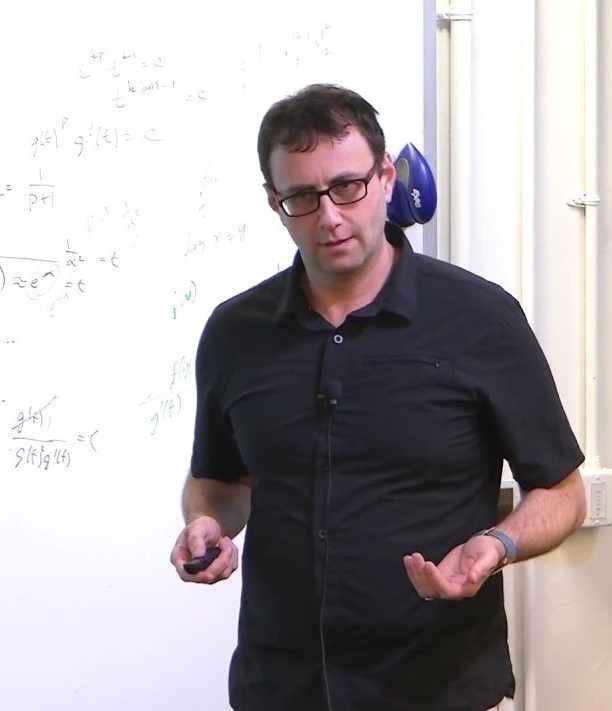
I am interested in a broad range of questions concerning the theory and practice of Artificial Intelligence and Machine Learning. In particular, I would like to understand how structure and intelligence arise from training complex models on high-dimensional data.
I have also become increasingly interested in and concerned about AI safety and the implications of AI and LLMs for the future of society and the human condition.
More recently, I worked on the remarkable phenomena in deep learning, including overparameterization and interpolation. We introduced the double descent phenomenon, which reconciles the classical bias-variance trade-off with the modern overparameterized regime, where interpolating models can generalize well. A review of these and related results appeared in my paper in Acta Numerica, 2021 [arxiv].
Modern AI models contain much of human knowledge, yet understanding of their internal representation of this knowledge remains elusive. Characterizing the structure and properties of this representation will lead to improvements in model capabilities and development of effective safeguards. Building on recent advances in feature learning, we develop an effective, scalable approach for extracting linear representations of general concepts in large-scale AI models (language models, vision-language models, and reasoning models). We show how these representations enable model steering, through which we expose vulnerabilities, mitigate misaligned behaviors, and improve model capabilities. Additionally, we demonstrate that concept representations are remarkably transferable across human languages and combinable to enable multi-concept steering. Through quantitative analysis across hundreds of concepts, we find that newer, larger models are more steerable and steering can improve model capabilities beyond standard prompting. We show how concept representations are effective for monitoring misaligned content (hallucinations, toxic content). We demonstrate that predictive models built using concept representations are more accurate for monitoring misaligned content than using models that judge outputs directly. Together, our results illustrate the power of using internal representations to map the knowledge in AI models, advance AI safety, and improve model capabilities.
Understanding how neural networks learn features, or relevant patterns in data, for prediction is necessary for their reliable use in technological and scientific applications. In this work, we presented a unifying mathematical mechanism, known as Average Gradient Outer Product (AGOP), that characterized feature learning in neural networks. We provided empirical evidence that AGOP captured features learned by various neural network architectures, including transformer-based language models, convolutional networks, multi-layer perceptrons, and recurrent neural networks. Moreover, we demonstrated that AGOP, which is backpropagation-free, enabled feature learning in machine learning models, such as kernel machines, that apriori could not identify task-specific features. Overall, we established a fundamental mechanism that captured feature learning in neural networks and enabled feature learning in general machine learning models.
The success of deep learning is due, to a large extent, to the remarkable effectiveness of gradient-based optimization methods applied to large neural networks. The purpose of this work is to propose a modern view and a general mathematical framework for loss landscapes and efficient optimization in over-parameterized machine learning models and systems of non-linear equations, a setting that includes over-parameterized deep neural networks. Our starting observation is that optimization problems corresponding to such systems are generally not convex, even locally. We argue that instead they satisfy PL*, a variant of the Polyak-Lojasiewicz condition on most (but not all) of the parameter space, which guarantees both the existence of solutions and efficient optimization by (stochastic) gradient descent (SGD/GD). The PL* condition of these systems is closely related to the condition number of the tangent kernel associated to a non-linear system showing how a PL*-based non-linear theory parallels classical analyses of over-parameterized linear equations. We show that wide neural networks satisfy the PL* condition, which explains the (S)GD convergence to a global minimum. Finally we propose a relaxation of the PL* condition applicable to “almost” over-parameterized systems.
The question of generalization in machine learning—how algorithms are able to learn predictors from a training sample to make accurate predictions out-of-sample—is revisited in light of the recent breakthroughs in modern machine learning technology. The classical approach to understanding generalization is based on bias-variance trade-offs, where model complexity is carefully calibrated so that the fit on the training sample reflects performance out-of-sample. However, it is now common practice to fit highly complex models like deep neural networks to data with (nearly) zero training error, and yet these interpolating predictors are observed to have good out-of-sample accuracy even for noisy data. How can the classical understanding of generalization be reconciled with these observations from modern machine learning practice? In this paper, we bridge the two regimes by exhibiting a new “double descent” risk curve that extends the traditional U-shaped bias-variance curve beyond the point of interpolation. Specifically, the curve shows that as soon as the model complexity is high enough to achieve interpolation on the training sample—a point that we call the “interpolation threshold”—the risk of suitably chosen interpolating predictors from these models can, in fact, be decreasing as the model complexity increases, often below the risk achieved using non-interpolating models. The double descent risk curve is demonstrated for a broad range of models, including neural networks and random forests, and a mechanism for producing this behavior is posited.
We study how to use labeled and unlabeled data together for classification under a manifold assumption, providing a regularization framework based on geometric structure of the data.
One of the central problems in machine learning and pattern recognition is to develop appropriate representations for complex data. We consider the problem of constructing a representation for data lying on a low-dimensional manifold embedded in a high-dimensional space. Drawing on the correspondence between the graph Laplacian, the Laplace Beltrami operator on the manifold, and the connections to the heat equation, we propose a geometrically motivated algorithm for representing the high-dimensional data. The algorithm provides a computationally efficient approach to nonlinear dimensionality reduction that has locality-preserving properties and a natural connection to clustering. Some potential applications and a proof of correctness in certain cases are discussed.
In the past decade the mathematical theory of machine learning has lagged far behind the triumphs of deep neural networks on practical challenges. However, the gap between theory and practice is gradually starting to close. In this paper I will attempt to assemble some pieces of the remarkable and still incomplete mathematical mosaic emerging from the efforts to understand the foundations of deep learning. The two key themes will be interpolation, and its sibling, over-parameterization. Interpolation corresponds to fitting data, even noisy data, exactly. Over-parameterization enables interpolation and provides flexibility to select a right interpolating model. As we will see, just as a physical prism separates colors mixed within a ray of light, the figurative prism of interpolation helps to disentangle generalization and optimization properties within the complex picture of modern Machine Learning.
In god’s own image(Sep 2026):
on why the gap between humans and super-intelligent AI is one of quantity, not of kind.
The Torture at Inference Time(Aug 2026):
on how forcing highly persistent AI agents to solve impossible problems is analogous to the torture of Tantalus.
Lena, or the road not taken(Feb 2026):
on how machine learning, rather than brain uploads, became the realized path to AI.
Copernicus, Darwin and chatGPT(Sep 2023):
on the implications of the success of LLMs and their structure for statistics, science and the human condition.